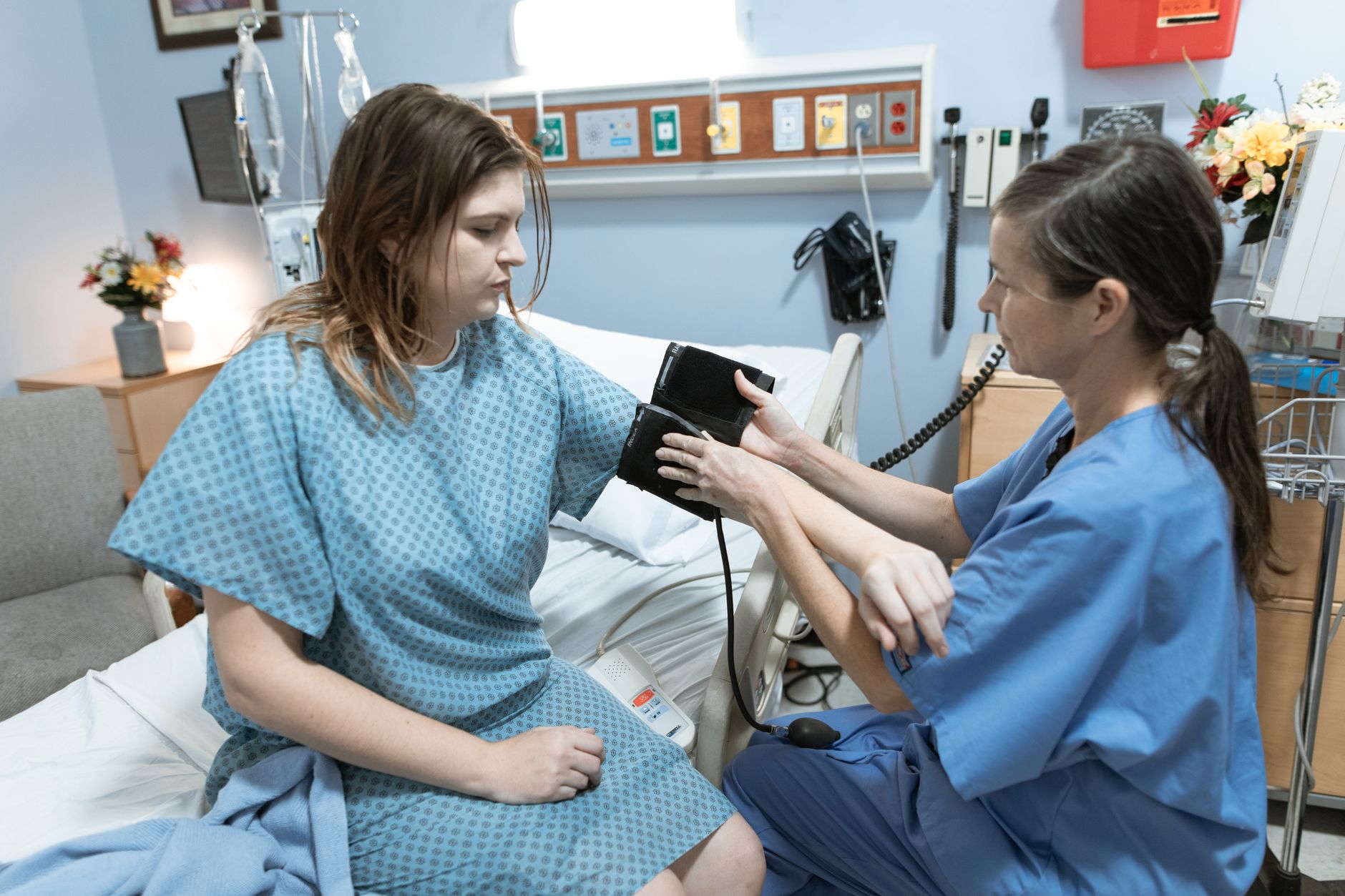
A nurse trained outside the EU and EEA cannot start working as a nurse in Sweden while her application is processed. The title nurse is protected by law, and only a licensed nurse may use it. While she waits for a decision, she may work in a health care profession that requires neither a license nor a protected professional title. Before the license is issued, she has to complete five steps set by Socialstyrelsen, the National Board of Health and Welfare. They are an assessment of her education, a proficiency test held in Swedish, a course in Swedish laws and regulations, three months of clinical training and the license application itself, which must include proof of her Swedish.
The license comes before the nursing job
A Swedish license is required to practice as a nurse in Sweden. Once Socialstyrelsen has made its decision, your details are entered in HOSP, the register of licensed health care professionals that employers search. You may start practicing as soon as you receive the license. If a region’s job offer is conditional on a license, the nursing job starts when the license is issued, not when the application is filed.
While you wait, you can take work that requires neither a license nor proof of a protected professional title. In those roles the employer decides whether you have the right skills.
Assistant nurse (undersköterska) is not one of those roles. It is a protected professional title with its own application to Socialstyrelsen, separate from the nursing license.
Your right to live and work in Sweden is a separate matter, decided by the Swedish Migration Agency. The agency handles residence and work permits.
Nurses trained outside the EU and EEA complete five steps before the license
Socialstyrelsen lists the steps in this order. The proficiency test requires an approved assessment, and both the law course and the clinical training require a passed test.
- Have your education assessed. Socialstyrelsen compares your nursing education with the Swedish one on level, length and content. You send copies of your diploma and of a certificate listing your courses and the length of the program, in the original language and translated into Swedish or English. Documents in Swedish, Norwegian, Danish or English do not need to be translated. The fee is SEK 990, and an assessment takes about three months. You need neither Swedish, a Swedish personal identity number nor a residence permit for this step. If your education is not approved, you cannot continue on this route.
- Take the proficiency test. The test is held in Swedish. The University of Gothenburg arranges it on behalf of Socialstyrelsen. It has a theoretical part and a practical part, and you must pass the theoretical part before you may take the practical one. You have up to five attempts at the theoretical part and three at the practical part. The whole test, both the theoretical and the practical part, must be passed within five years of the first test sitting. Extra attempts cannot be requested.
- Take the course in Swedish laws and regulations. Once Socialstyrelsen has decided that you passed the test, you can sign up for a free online course at Lund University on the laws that govern Swedish health care. You can study full-time or part-time. You must pass the course to be granted a license.
- Complete three months of clinical training. You can start when you have passed the entire proficiency test. You find the workplace yourself and do all of the training there, and the workplace decides whether it is suitable for the training. Previous work as a nurse does not shorten the period, and Socialstyrelsen gives no financial aid during it. The law course can be taken before, after or alongside the training, though not during working hours.
- Apply for the license. You send the application form, a copy of your passport, a copy of your certificate of Swedish proficiency and the original certificate of clinical training. Applicants without a Swedish personal identity number or coordination number also send a copy of the certificate from the law course. If you paid SEK 990 for the assessment, you do not pay again. A complete application currently takes about two to four weeks, and Socialstyrelsen checks police records before deciding. You need a Swedish personal identity number or coordination number at this step. If you have neither, Socialstyrelsen asks the Swedish Tax Agency to assign you a coordination number.
Nurses need Swedish from the proficiency test, but the certificate comes last
You do not need Swedish to have your education assessed. From the proficiency test onward, you do. The certificate of your language skills must be sent no later than with the license application. Socialstyrelsen accepts an approved grade or certificate in one of the following:
- Swedish 3 or Swedish as a Second Language 3, for example at municipal adult education (Komvux).
- Swedish at level C1 of the Common European Framework of Reference for Languages.
- A course or exam that meets the Swedish entry requirements for higher education.
- Equivalent proficiency in Norwegian or Danish.
A health care provider can also assess whether you have the Swedish needed to work in the profession, using Socialstyrelsen’s form for the assessment. The form states that your Swedish must correspond to level C1, and the general advice in the regulations for education from outside the EEA points to the same level.
Getting a Swedish nursing license usually takes two to four years
On the Socialstyrelsen route, the steps usually take two to four years in total. There is a second route: a complementary program at a Swedish university, which usually takes one to three years from admission to license. Places are limited, each university sets its own entry requirements, and many universities require a decision from Socialstyrelsen that your education is equivalent to the Swedish one. Both routes end with the same license application.
With a conditional offer, the start date depends on all five steps, not only on the final application. For the three months of clinical training, the region that made the offer is one place to ask for a workplace.
Pharmacists trained outside the EU and EEA follow a similar five-step route with different details, described in the guide to working as a pharmacist in Sweden with a foreign degree.
This is general information, not legal advice.
Last fact-checked: 14 October 2026